
 Posts
Posts


Well they went and extended the federal budget for another 10 months.with 1500 pages of legalese loaded with carve outs, handouts, and designations for little pet projects back in their home districts, all you got it do is,... pay for it! Only 1.012 TRILLION dollars for 10 more months? Do You mean its gonna be another shutdown at Christmas next year? Under another vindictive and hostile lame duck congress? Will obamacare regulations allow us to have Christmas next year or will the death-panel deem the festivities unhealthy? We started paying for it four years before it even began! Remember hoping for change for the better? Remember fundamental transformation from the most powerful Undocumented Worker ever?
I think in my head,.. hmm? What just happened again?
As my mind scans the past five years worth of memories,it remembers something before the election, around October 2007. Lets write it this way, 10th month of 2007. Now it clicks, like hind sight 20/20 in my mind! This was the start of the CHAOS in America in my mind as my query was answered in a bible verse. That verse is found in Psalm 107 verse 10. It reads in verse 10, "Such as sit in darkness and in the shadow of death, being bound in affliction and iron", it describes the average secular American or implanted liberal condition. Look, everyone is a sinner, and I know nobody is perfect, but take a minute to read the next verse. Verse 11 answers the question "Why?" with,"Because they rebelled against the words of God and contemned the Council of the most High!". They, voted in their own Messiah that year. Their Messiah thanked them by telling them they were really somebody and showering them with gifts of all sorts, grants for green energy, special favors for friends with special interests and hidden agendas. They, the American voter/supporters, took the bait hook, line, and sinker! The trap was sprung and no one escapes!
Somebody "Stimulated the world" on the backs of the then working middle class majority that year! Blame it on the messiah hmm? History will show the decline into a divided foe banana republic government under a global hierarchy before too long. Interpret it for your self in Psalm 109, see if you and the then young king David don't have common interests like you did in 2009, 2010, 2011, and so on. Remember there will be microchips implanted into every man woman and child on the planet by the end of 2017 according to the 80% Islamic U.N. agenda, Psalm 117 applies. Its the shortest book in the bible. Let it speak to that God shaped vacuum in your heart.
If you have any questions Psalm 118:8 will get to the heart of the matter, and its the very center verse of the whole bible with an equal number of verses before and after. Simply it says, "It is better to trust in the Lord than to put confidence in man."
Already we war against U.N. Agenda 21 in our back yards, & EPA in the front yard looking for exotic endangered species living in your lawn if you violate a mowing ordinance!
Special Interest Czars have been writing on average 75,000 new rules and regulations EVERY single year since! Good Lord! the bible is only 5000 pages and it doesn't even have a law, rule or regulation on every page.
I saw an interesting post on twitter, explaining how much 1 trillion is. Any mathematician will tell you that 1 trillion is 1000 billions and a billion is 1000 millions, and a million is 1000 hundreds and so on. So how do you wrap your head around 1 trillion? 1 trillion seconds = 32,000 years so @ $1.00 per second, pay back will take that long
Friday, January 17, 2014


Thursday, January 9, 2014
Government Data-Mining?
Sent: Thursday, January 9, 2014 3:37 PM
Subject: Fwd: PLEASE MAKE CALLS ON COMMON CORE DATA MINING FUNDING - January 9th
Subject: Fwd: PLEASE MAKE CALLS ON COMMON CORE DATA MINING FUNDING - January 9th
On Wednesday, January 8th the Joint Finance Committee voted 8-7 to fund the State Student Information System (SSIS). This system is an integral part of the data mining mechanism needed for Common Core and Race To The Top.
7 republicans failed to vote against this measure. Senators Olsen, Harsdorf, Darling and Liebham and Representatives Nygren and Kooyenga voted to fund the data mining system. Representative Klenke was absent and did not cast a vote.
If even one of these legislators had voted against funding the SSIS a major component of the Common Core takeover would have been given a huge blow.
Please take some time today to call these legislators and let them know that you do not appreciate their position on the SSIS. You could say something like:
"Good afternoon, I see that _____________ voted for the Statewide Student Information System. This system is an enabling technology for invasion of student and parent privacy by the state and potentially by the federal government and corporations. It is integral to the data mining initiatives related to Common Core coming from the Department of Education. I do not appreciate your vote in the affirmative and would hope that you would reconsider your position to protect our children's privacy in the future."
Please also forward this message to your email lists and share on social media so that more people can help in this effort!
Together we will rid Wisconsin of Common Core!
Also when making your Calls to these Senators don't forget to
mark your Calander and attend the upcoming Green Bay TEA Party
Meeting In Green Bay Jan. 14th!
See: http://www.greenbayteaparty.
Here is the list of Senators to call:
Sen. Joseph Leibham
President Pro Tempore
Phone: 608-266-2056
Email: Sen.Leibham@legis.wisconsin.
Sen. Sheila Harsdorf
Caucus Vice Chairperson
Phone: 608-266-7745
Email: Sen.Harsdorf@legis.wisconsin.
Sen. Alberta Darling
Phone: 608-266-5830
Email: Sen.Darling@legis.wisconsin.
Luther Olsen
Phone: 608-266-0751
Email: Sen.Olsen@legis.wisconsin.gov
Rep. John Nygren
Phone: (608) 266-2343
Rep. Dale Kooyenga
Phone: (608) 266-9180
Rep. John Klenke (did not vote)
Phone: (608) 266-0485
mark your Calander and attend the upcoming Green Bay TEA Party
Meeting In Green Bay Jan. 14th!
See: http://www.greenbayteaparty.
Tuesday, December 31, 2013
Hustisford's Famous Toilet-Bowl Parade is Tomorrow!
Here in Hustisford, WI, we have an event called the annual toilet bowl parade.
On the first day of every new year we gather in the downtown area and watch local artisans parade their home-made floats to welcome in the new year. Almost everybody comes armed with rolls of toilet paper. Some say the toilet paper is for runny noses, while others prefer to bombard the floats passing by on Main Street. I feel the toilet paper is semi - symbolic for the annual toilet bowl football game which is usually held on the ice out on the lake. Legend has it, that the toilet paper originally was used as padding to protect the football players. Others will tell you the mess of paper in the streets is just job security for the local street department. The last time I got pelted by a roll, it was meant to get my attention by a friend in the crowd across the street. It worked!
The parade is scheduled to start at noon. The weather forecasts light snow, with temperatures around 18 degrees. There will also be food and beverages at Fireman's Hall afterwards. Proceeds raised to benefit our local fire department.
The parade promises some family friendly fun time where the toilet paper will fly freely and so will the beer if you want. Remember, this is Wisconsin we have no problem keeping the beer cold, after all this is our winter wonderland. Enjoy it
Wednesday, December 11, 2013
George Orwell's 1984 vs CCSS
Dear Folks,
Teachers will be under very intense pressure to teach what has been programmed for them to teach. The teachers effectiveness and progress will be monitored and measured by the many tests to which the students will subject.
Bear in mind that the elimination of Common Core will not end the data collection of the never ending testing which may be disguised as simple class room exercises.
Separate contracts have been signed with 'Infinite Campus"and "Skyward" companies for the collection of some four hundred to five hundred or more data points. These contracts will not be affected by any demise of Common Core State Standards.
Teachers will be under very intense pressure to teach what has been programmed for them to teach. The teachers effectiveness and progress will be monitored and measured by the many tests to which the students will subject.
Bear in mind that the elimination of Common Core will not end the data collection of the never ending testing which may be disguised as simple class room exercises.
Separate contracts have been signed with 'Infinite Campus"and "Skyward" companies for the collection of some four hundred to five hundred or more data points. These contracts will not be affected by any demise of Common Core State Standards.
Common Core could be viewed as the Trojan Horse to ease, hide, disguise or distract from the implementation of the data collection schemes. I believe the data collection schemes are far more sinister than Common Core.
Skyward claims to be a Wisconsin based company although it is noted to be a world wide international company. Upon a deeper study it appears that eventually almost everyone would be able to access the data no matter how private, except the student and parents.
Skyward claims to be a Wisconsin based company although it is noted to be a world wide international company. Upon a deeper study it appears that eventually almost everyone would be able to access the data no matter how private, except the student and parents.
The data collection schemes will produce a psychological/psychiatric profile of the student and perhaps the mindset of those in the students home.
Having that information, a grade school child could/would be "channeled" beginning in the elementary grades as suggested by various DVDs, into becoming a manual laborer, doctor, lawyer, janitor or government worker etc.
Worse yet, if it is desired to change or alter the students profile and/or belief system to what the government thinks it should be computer programs will be able to guide the remedial education required to make the necessary changes. The students daily activity as monitored by his/her tablet will monitor the correction progress. If the teacher is ineffective in enforcing the computer dictated changes he/she will be disciplined or replaced.
Every computer/tablet has an "administrator" position within it which could be made inaccessible to the student and/or parent. The administer position can simultaneously hold many names such as the U.S. Government, Superintendent of Public instruction, school administrator or teacher. The administrator position has complete control over the unit, its allowed input, what will be deleted and when..I have heard some tablets will contain GPS functions. Elimination of common core will not affect these operations.
Technology has made many advances since publication of the book titled 1984. Text books are being phased out. The average parent will have absolutely no idea to what the student will be exposed during the school day.
Technology has made many advances since publication of the book titled 1984. Text books are being phased out. The average parent will have absolutely no idea to what the student will be exposed during the school day.
Profiling is nothing new as mental profiling by employers and the military and others has been with us for sixty or more years, just an updated technology misapplied. As with Saul Alinsky, "the issue is never the issue".
Wednesday, August 14, 2013
Are You Tweaking Your Gen. #1 Wood Beaver?
About a year and a half ago we realized the need to make our "all in one", Wood Beaver firewood processors for the ordinary average "Joe". I am honored to have met a few of you, I am one of the guys you saw, or spoke to, on the shop floor perhaps during your purchase or when ya picked it up. I wrote this for the self sufficiency of the survivalists out there.
This thing ain't your dad's light duty week-end of work log split-er. That being said, I realized the guy who will need to fix it in the field will probably need a guide from the builder's perspective, a sort of "how to make metal bend when your not superman" option.

A DIY’ers Guide to Wedge Alignment...
Let’s face it, Mother Nature is not perfect, trees don’t always grow straight. So, it goes without saying trees are not always cut straight at 90 degrees. Perhaps someone set a widow maker with its crooked edge first on the in feed table and it happens to twist up the business end of your machine. What can you do if tough wood seems to be knocking your wedge too far back, or to one side constantly?
Your Wood Beaver Firewood Processor is built with enough movement built in for the splitting lift of the log as it passes by the wedge. Because of customer demand, for adjust-ability in the wedge height for accommodation of varying wood sizes, we designed a linkage system with 1 lift pin at the wedge, and a pivot point at the handle’s pivot point. The handle pin is generally welded into the wedge linkage, however there are some older models where this may not be the case.
There are three items built into every Wood Beaver that can have an impact on your wedge alignment. Take a moment to familiarize yourself with the included illustrations. The individual components are the wedge reinforcement, the wedge lift linkage, and the wedge backer plate.
First let’s take a look at how the splitting process works. This process begins when the wood falls into the bed after the saw bar cuts it to the length you desired. Always make sure it is aligned with the push block track in the bottom of the bed. The wedges will not crosscut against the grain of the wood. This can become a problem with log ends or short lengths. The branch wood that causes knots in lumber generally taps into the heartwood of the log. It will pop with the grain of the wood surrounding it. Branch snags not trimmed in the tree felling process can affect how a log lays in the bed of the machine. It is a good practice to inspect the log for such problems prior to placing it on the machine.
Another rule of thumb is to try to split the wood from the top of the tree towards the bottom, just like when you used to hand split firewood. With a little planning you will enjoy your Wood Beaver Firewood Processor for years

Depending on which wedge you have in your processor, the process is the same, as the wedge itself is allowed to lift up to 8 ½”, the approximate center of a 16” log. It is recommended that you do not attempt to split larger than a 16” diameter log. Although a larger log will physically fit, when it passes through the wedge, the lift of the log as it splits will cause excess stress to the wedge wings of the wedge. This is not an issue with the 4 – way wedge, however, the 6 – way wedges have double the surface contact area, causing some distortion or twisting when splitting at the wedge’s highest elevation setting. The wings of the wedge have a -4 degree pitch designed to help the wedge pull itself down as the wood passes through, but the wood itself is still slightly bound by the wedge retainer until it clears the cutting edge. The general rule of thumb is to never split wood with the wings above the wedge backer behind the wedge. The wedge is a replaceable component, if it is stressed, and damaged it can be replaced or repaired in a well-equipped shop. We will discuss the how to repair a heat treated wedge latter in this article.
Starting at the rear of the processor, let’s consider each component, its function, and what you can do if a failure occurs.
Every component is confined by the “Wedge Retainer Assembly”. This is what holds the wood in place against the combined forces of the push block or ram stroke. It is an integrated appendage of the trough bed, with the same anchor as the ram. The 5/8” x 3” HR has the same 2 degree pitch as the trough, meaning it will be a wider gap on the bottom than it is on the top side. The slightly wider bottom is to facilitate less binding from debris. The end plate is the only fail safe against bending or warping the guide slot of the ram and push block. Basically a failure here, or a “blowout”, needs immediate attention as the “wood splitting” stops. Fortunately the split is only the last step of the firewood, you can still harvest firewood until the end of the day.
“So, what can you do now?” The spliter may be down, but you still have the saw, the ram and the bed, right? If you still have that pile of logs 3” – 12” you can still cut firewood to length and the ram will still feed the conveyor, however, the conveyor is not recommended for large diameter logs (10” or bigger) as there may be increased safety risks.
First clear the machine of any wood in the trough, and grate area.
Remove wedge lift pin, lift wedge from its retainer assembly.
Unbolt and remove the wedge backer plate, continue cutting firewood to length and cycle the splitting ram as normal to move the wood forward through the grate area to the conveyor.
We recommend a qualified welder perform some of the specific repairs and retrofitting procedures we have outlined for a failure of such magnitude. Wood Beaver stands behind our product, and we are working to ensure a superior value.
Obviously the larger the wood diameter is, the larger the stress on the individual components. There are steps you can take to ensure the longevity of your Wood Beaver’s individual components beyond the retainer assembly failure mentioned above.
The wedge backer plate is intended as a guide for the upper portion of the wedge. It provides support behind the wedge only when all clearance is exhausted from the force of the ram on the wood. The force is then exerted against the bolts in both the retainer plates and the ½” bolt in the bottom mounting tabs by resting against the end plate of the wedge retainer assembly. If it becomes bent, across the 3” dimension it should be replaced. It can be removed and straightened if it should bend across the 5/8” dimension. It is expected that the ram force will shear the bolts and push the wedge through the end plate if the wedge slips to the side of the wedge reinforcement.

Minor adjustments to the left or right of a vertical line can be made to the wedge backer’s alignment by slightly bending the backer’s body to frame mounting tabs located below the grate at the rear of the machine. Do not hesitate cutting back an inch of weld with a grinder to open up or close the tabs on the top of the tab at the backside of the wedge if it is determined to bind excessively or causes the wedge to lean to the left or right of vertical alignment.
You may also consider welding some guide tabs to the backside of the wings on your standard 4 – way splitting wedge. If you do, I suggest allowing a 1/8” gap between the guide tab and the wedge backer plate. This will ensure enough movement as the log lifts and it splits, also you do not need your wedge binding in an elevated position before the next piece starts its cycle.
Now that we have discussed the backside of the wedge, let’s take a look at the linkage that lifts the wedge up and down. We have added centering tubes to the inside surfaces to help guide the bottom end of the wedge. They also help to stiffen the linkage like a link of a roller chain, to limit the extreme twisting forces that may occur on the topside. Should the linkage become damaged, twisted or bent, it is simple enough to disassemble, remove, and perform maintenance in the field. Usually several liberal blows of a heavy hammer will straighten any alignment issues. If the bend is extreme, a mounted vise may be required to hold it while a long bar or piece of 1” shaft w/ a cheater pipe can un-twist a bent linkage.
Note that the wedge lift handle must remain secured in a lock slot throughout the splitting process. If it is lose, increasing pressure of the handle spring, or even wrapping it in position with a bungee strap will help keep it in place. An unlocked handle can lead to a major lifting of the wedge, resulting in a failure of the wedge retainer assembly.
While we are discussing the components below the bed of your processor, let’s move forward to the wedge reinforcement or wedge rein for short. The wedge rein cantilevers the force exerted against the wedge above the bed of the machine to the toe of the wedge below because it is a solid appendage of the bed’s fulcrum through the push block guide track or slot between the bed halves. The force of the ram is transferred through the wedge to its toe at the bottom; therefore it is critical that every piece aligns with the rein.
It is recommended that you periodically check the alignment below the bed as well as on the top side. Should you determine that the rein is out of a vertical alignment it can easily be realigned with a large pipe wrench and a 4 foot piece of cheater pipe or handle extension. You should add a short piece of c- channel or heavy plate inside of the jaw of the wrench to avoid curling the reinforcement bar. 6 or 7” will ensure the bending process occurs as close to the bed as possible. You do not want to curl the rein.
It may be that a torch is needed to heat the bar to a dull red to assist in bending the bar at the point desired. If a torch is not handy, but you do have a bottle jack or a floor jack, simply set the feet of the machine, to the down position to stabilize the processor. Place the wrench handle in the direction you want to bend the rein, and then place the jack under the cheater pipe. The pressure of the jack will overcome the resistance of the steel bar.
We have included some pictures to show you some of the damage that can happen in a so called catastrophic failure. We hope you will watch for proper alignment to avoid premature failure of the spliter portion of your Wood Beaver Firewood Processor.
This thing ain't your dad's light duty week-end of work log split-er. That being said, I realized the guy who will need to fix it in the field will probably need a guide from the builder's perspective, a sort of "how to make metal bend when your not superman" option.

A DIY’ers Guide to Wedge Alignment...
Let’s face it, Mother Nature is not perfect, trees don’t always grow straight. So, it goes without saying trees are not always cut straight at 90 degrees. Perhaps someone set a widow maker with its crooked edge first on the in feed table and it happens to twist up the business end of your machine. What can you do if tough wood seems to be knocking your wedge too far back, or to one side constantly?
Your Wood Beaver Firewood Processor is built with enough movement built in for the splitting lift of the log as it passes by the wedge. Because of customer demand, for adjust-ability in the wedge height for accommodation of varying wood sizes, we designed a linkage system with 1 lift pin at the wedge, and a pivot point at the handle’s pivot point. The handle pin is generally welded into the wedge linkage, however there are some older models where this may not be the case.
There are three items built into every Wood Beaver that can have an impact on your wedge alignment. Take a moment to familiarize yourself with the included illustrations. The individual components are the wedge reinforcement, the wedge lift linkage, and the wedge backer plate.
First let’s take a look at how the splitting process works. This process begins when the wood falls into the bed after the saw bar cuts it to the length you desired. Always make sure it is aligned with the push block track in the bottom of the bed. The wedges will not crosscut against the grain of the wood. This can become a problem with log ends or short lengths. The branch wood that causes knots in lumber generally taps into the heartwood of the log. It will pop with the grain of the wood surrounding it. Branch snags not trimmed in the tree felling process can affect how a log lays in the bed of the machine. It is a good practice to inspect the log for such problems prior to placing it on the machine.
Another rule of thumb is to try to split the wood from the top of the tree towards the bottom, just like when you used to hand split firewood. With a little planning you will enjoy your Wood Beaver Firewood Processor for years
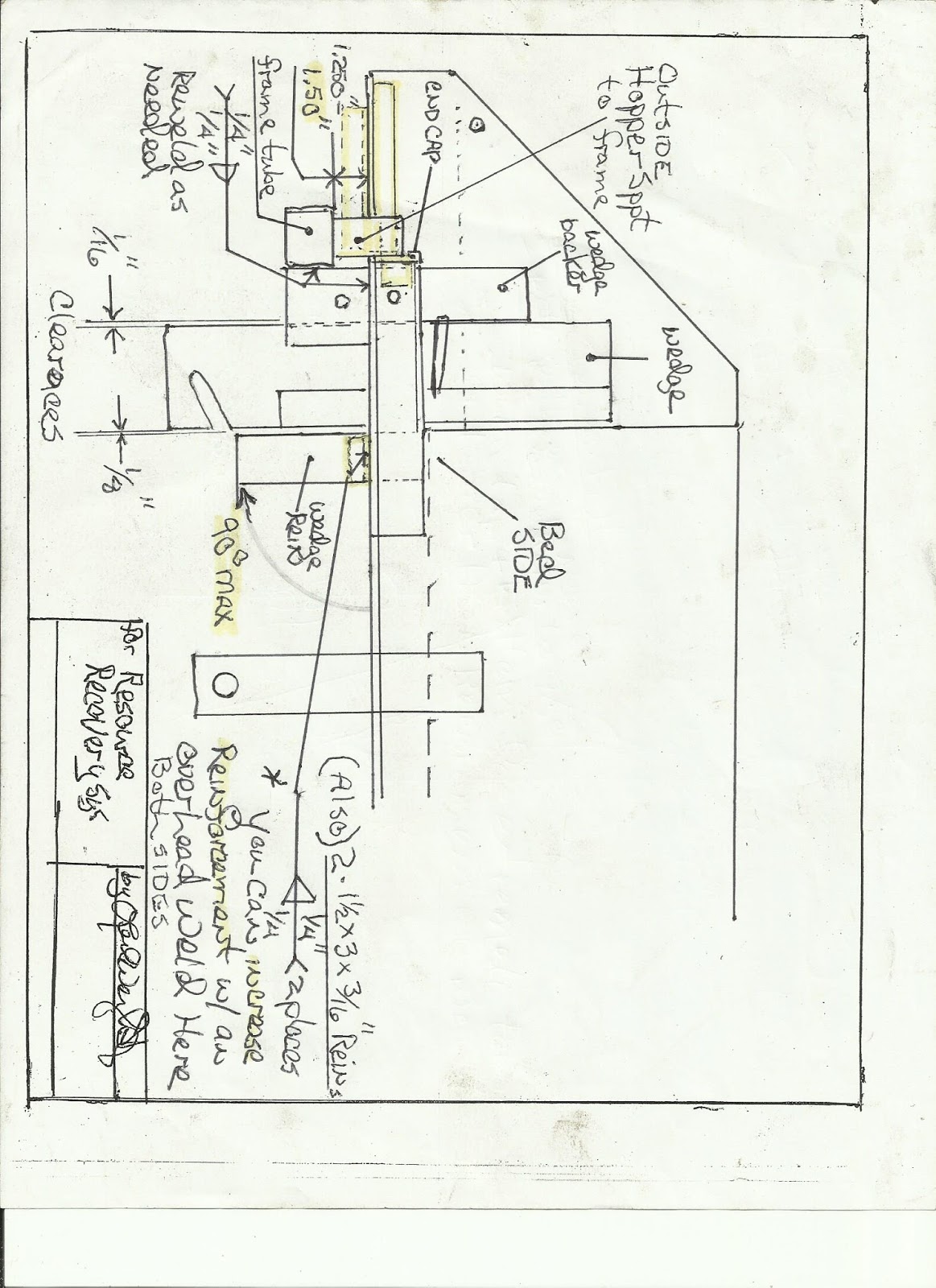
Depending on which wedge you have in your processor, the process is the same, as the wedge itself is allowed to lift up to 8 ½”, the approximate center of a 16” log. It is recommended that you do not attempt to split larger than a 16” diameter log. Although a larger log will physically fit, when it passes through the wedge, the lift of the log as it splits will cause excess stress to the wedge wings of the wedge. This is not an issue with the 4 – way wedge, however, the 6 – way wedges have double the surface contact area, causing some distortion or twisting when splitting at the wedge’s highest elevation setting. The wings of the wedge have a -4 degree pitch designed to help the wedge pull itself down as the wood passes through, but the wood itself is still slightly bound by the wedge retainer until it clears the cutting edge. The general rule of thumb is to never split wood with the wings above the wedge backer behind the wedge. The wedge is a replaceable component, if it is stressed, and damaged it can be replaced or repaired in a well-equipped shop. We will discuss the how to repair a heat treated wedge latter in this article.
Starting at the rear of the processor, let’s consider each component, its function, and what you can do if a failure occurs.
Every component is confined by the “Wedge Retainer Assembly”. This is what holds the wood in place against the combined forces of the push block or ram stroke. It is an integrated appendage of the trough bed, with the same anchor as the ram. The 5/8” x 3” HR has the same 2 degree pitch as the trough, meaning it will be a wider gap on the bottom than it is on the top side. The slightly wider bottom is to facilitate less binding from debris. The end plate is the only fail safe against bending or warping the guide slot of the ram and push block. Basically a failure here, or a “blowout”, needs immediate attention as the “wood splitting” stops. Fortunately the split is only the last step of the firewood, you can still harvest firewood until the end of the day.
“So, what can you do now?” The spliter may be down, but you still have the saw, the ram and the bed, right? If you still have that pile of logs 3” – 12” you can still cut firewood to length and the ram will still feed the conveyor, however, the conveyor is not recommended for large diameter logs (10” or bigger) as there may be increased safety risks.
First clear the machine of any wood in the trough, and grate area.
Remove wedge lift pin, lift wedge from its retainer assembly.
Unbolt and remove the wedge backer plate, continue cutting firewood to length and cycle the splitting ram as normal to move the wood forward through the grate area to the conveyor.
We recommend a qualified welder perform some of the specific repairs and retrofitting procedures we have outlined for a failure of such magnitude. Wood Beaver stands behind our product, and we are working to ensure a superior value.
Obviously the larger the wood diameter is, the larger the stress on the individual components. There are steps you can take to ensure the longevity of your Wood Beaver’s individual components beyond the retainer assembly failure mentioned above.
The wedge backer plate is intended as a guide for the upper portion of the wedge. It provides support behind the wedge only when all clearance is exhausted from the force of the ram on the wood. The force is then exerted against the bolts in both the retainer plates and the ½” bolt in the bottom mounting tabs by resting against the end plate of the wedge retainer assembly. If it becomes bent, across the 3” dimension it should be replaced. It can be removed and straightened if it should bend across the 5/8” dimension. It is expected that the ram force will shear the bolts and push the wedge through the end plate if the wedge slips to the side of the wedge reinforcement.

Minor adjustments to the left or right of a vertical line can be made to the wedge backer’s alignment by slightly bending the backer’s body to frame mounting tabs located below the grate at the rear of the machine. Do not hesitate cutting back an inch of weld with a grinder to open up or close the tabs on the top of the tab at the backside of the wedge if it is determined to bind excessively or causes the wedge to lean to the left or right of vertical alignment.
You may also consider welding some guide tabs to the backside of the wings on your standard 4 – way splitting wedge. If you do, I suggest allowing a 1/8” gap between the guide tab and the wedge backer plate. This will ensure enough movement as the log lifts and it splits, also you do not need your wedge binding in an elevated position before the next piece starts its cycle.
Now that we have discussed the backside of the wedge, let’s take a look at the linkage that lifts the wedge up and down. We have added centering tubes to the inside surfaces to help guide the bottom end of the wedge. They also help to stiffen the linkage like a link of a roller chain, to limit the extreme twisting forces that may occur on the topside. Should the linkage become damaged, twisted or bent, it is simple enough to disassemble, remove, and perform maintenance in the field. Usually several liberal blows of a heavy hammer will straighten any alignment issues. If the bend is extreme, a mounted vise may be required to hold it while a long bar or piece of 1” shaft w/ a cheater pipe can un-twist a bent linkage.
Note that the wedge lift handle must remain secured in a lock slot throughout the splitting process. If it is lose, increasing pressure of the handle spring, or even wrapping it in position with a bungee strap will help keep it in place. An unlocked handle can lead to a major lifting of the wedge, resulting in a failure of the wedge retainer assembly.
While we are discussing the components below the bed of your processor, let’s move forward to the wedge reinforcement or wedge rein for short. The wedge rein cantilevers the force exerted against the wedge above the bed of the machine to the toe of the wedge below because it is a solid appendage of the bed’s fulcrum through the push block guide track or slot between the bed halves. The force of the ram is transferred through the wedge to its toe at the bottom; therefore it is critical that every piece aligns with the rein.
It is recommended that you periodically check the alignment below the bed as well as on the top side. Should you determine that the rein is out of a vertical alignment it can easily be realigned with a large pipe wrench and a 4 foot piece of cheater pipe or handle extension. You should add a short piece of c- channel or heavy plate inside of the jaw of the wrench to avoid curling the reinforcement bar. 6 or 7” will ensure the bending process occurs as close to the bed as possible. You do not want to curl the rein.
It may be that a torch is needed to heat the bar to a dull red to assist in bending the bar at the point desired. If a torch is not handy, but you do have a bottle jack or a floor jack, simply set the feet of the machine, to the down position to stabilize the processor. Place the wrench handle in the direction you want to bend the rein, and then place the jack under the cheater pipe. The pressure of the jack will overcome the resistance of the steel bar.
We have included some pictures to show you some of the damage that can happen in a so called catastrophic failure. We hope you will watch for proper alignment to avoid premature failure of the spliter portion of your Wood Beaver Firewood Processor.
Subscribe to:
Posts (Atom)
